Dubai Real Estate Mortgage Calculation: How to Finance Your Property Investment in 2026
Published 1 week ago
A mortgage is the most secured loan, and in Dubai, it is available not only for residents but also for non-residents and expats alike; let’s explore more.
Dubai continues to be a real estate market attraction for investors, end-users, expatriates, and international buyers seeking a combination of luxury living, capital appreciation, and rental income opportunities. From luxury beachfront residences and branded developments to family-friendly communities and off-plan projects, if you are buying properties in Dubai, the city offers options for almost every type of buyer.
However, not everyone purchases property with cash. Maybe people want to upgrade their lifestyle and move to Dubai, or an expat is finding a place to purchase, or buying investment property in Dubai. But not necessary that they would have the whole cash amount. Here, a mortgage helps a lot, and its best option for many investors and homeowners; it serves as the bridge between a dream property and actual ownership.
So, before buying property in Dubai, if you are short on funds and are looking for backup, understanding how mortgages in Dubai work, how mortgage calculations are performed, and what lenders look for can significantly improve your chances of making a smart and financially sustainable property purchase.
Whether you're buying your first home or adding another asset to your investment portfolio, knowing how mortgage financing works is essential in today's Dubai property market.
Why Do Buyers Use Mortgages in Dubai?

A mortgage is essentially a loan provided by a financial institution against the value of real estate property; in Dubai, it is used to help purchase real estate. Rather than paying the full property value upfront, buyers contribute a down payment and finance the remaining amount through monthly installments over a predetermined period.
Many buyers choose mortgages because they allow them to preserve liquidity, diversify investments, purchase higher-value properties, generate rental income while paying installments, and enter the property market earlier.
For investors, leveraging a mortgage can allow capital to be allocated across multiple opportunities rather than tying all funds into a single property.
Why Mortgages in Dubai's Property Market Matter
Dubai's growing population, expanding business environment, and continued infrastructure development have contributed to strong real estate demand. As property values increase in premium locations, mortgages provide accessibility to first-time buyers, expatriate residents, international investors, growing families, and long-term residents. And if a person is buying an investment property in Dubai, funding becomes a huge question.
Thus, mortgage loans in Dubai as a financing option have become an important tool that enables broader participation in Dubai's property market.
Understanding the Dubai Mortgage Calculator Logic
Before applying for financing, buyers should understand how the affordability of a mortgage in Dubai is determined. Several factors influence the calculation:

- Property Value: The total purchase price of the property.
- Down Payment: The amount paid upfront by the buyer.
- Loan Amount: The portion financed by the bank.
- Interest Rate: The percentage charged by the lender on the borrowed amount.
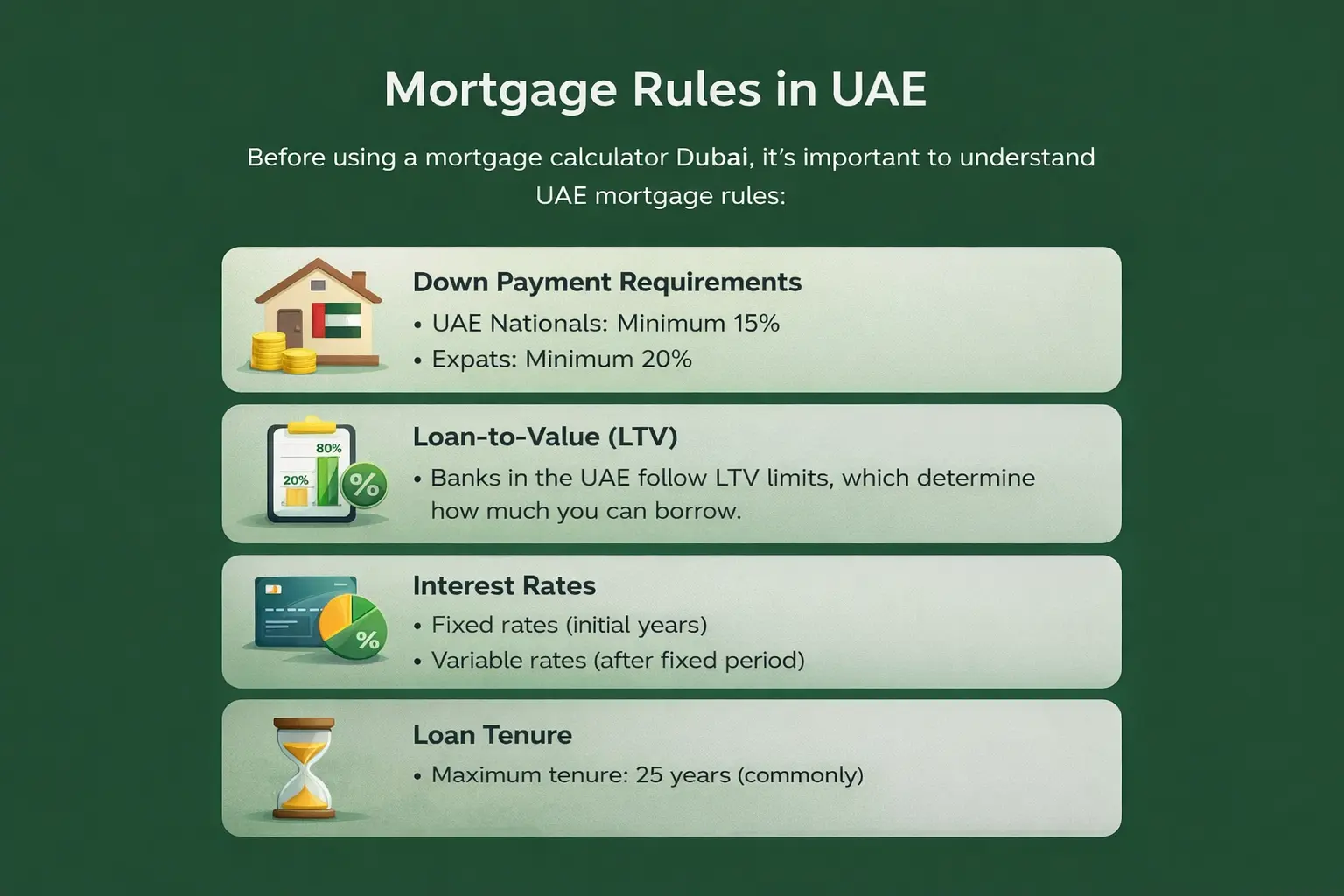
- Loan Tenure: The repayment period often ranges from 5 to 25 years.
- Monthly Income: Banks assess the applicant's earning capacity to determine affordability.
- Existing Financial Obligations: Credit card debt, personal loans, and other liabilities impact eligibility.
- Example Mortgage Scenario:
- Suppose a buyer purchases a property worth AED 2 million.
- So, here the property price is AED 2,000,000, and the down payment is 20%, which would be an amount of AED 400,000. Here, one can receive a mortgage amount of AED 1,600,000.
- Current Dubai Mortgage Rates: Currently, the rates range from 3.65% to 5.5% per annum. Rates are typically tied to the EIBOR (Emirates Interbank Offered Rate) plus a bank margin. Down payments range from 20% to 50% depending on the property value and your residency status, and you must meet the UAE Central Bank's 50% Debt-Burden Ratio (DBR) rule.
Taking these current Dubai mortgage rates as a base for calculation lets suppose you're an expatriate buying a ready property worth AED 5,000,000.
Item | Example Calculation |
Property Price | AED 5,000,000 |
Down Payment (20%) | AED 1,000,000 |
Mortgage Amount | AED 4,000,000 |
Interest Rate | 4.25% per annum (assumed) |
Loan Tenure | 25 years |
Estimated Monthly EMI | ~AED 21,600–22,000 |
Important Note Before Opting for a Mortgage Loan in Dubai:
- The monthly installment would then depend on the interest rate, Loan duration, and Mortgage type.
- A longer tenure may reduce monthly payments but increase total interest paid over time.
- A shorter tenure may increase monthly obligations while reducing overall financing costs.
- This is why mortgage planning should always be aligned with long-term financial goals.
Fixed vs Variable Interest Rates of Mortgages in Dubai
One of the most important financing decisions while investing in the Dubai real estate market involves choosing the interest structure.
- Fixed Rate Mortgage: The interest rate remains unchanged for a specified period. Its benefits include predictable payments, easier budgeting, and reduced exposure to market fluctuations.
- Variable Rate Mortgage: Here, the interest rate changes according to market conditions. Potential benefits include lower initial rates and the opportunity to benefit from declining interest environments. However, monthly payments may increase if rates rise.
Mortgage Eligibility in Dubai

Banks evaluate several criteria before approving the mortgage loan and providing financing. Meeting these requirements strengthens mortgage approval prospects. The common eligibility criteria include,
- Income Stability: Applicants must demonstrate consistent income.
- Employment Status: Salaried professionals and business owners may have different documentation requirements.
- Credit History: A strong credit profile improves approval chances.
- Debt Burden Ratio: Banks assess existing financial commitments relative to income.
- Age Requirements: Most lenders require borrowers to remain within specified age limits at loan maturity.
Key Documents Required for a Mortgage Loan in Dubai
Preparing documentation in advance can significantly streamline the approval process. Mortgage applications typically require:
- Identification Documents: Passport, Emirates ID (if applicable), Visa documentation, Income Verification, Salary certificates, Bank statements, Employment letters
- Business Documents (for entrepreneurs): Trade license, Company financial statements, Business banking records, Property Documentation, Sales agreement, Property details, Developer information (for off-plan purchases)
Due Diligence Before Taking a Mortgage in Dubai

Many buyers focus exclusively on loan approval; equally important is evaluating the property itself. A mortgage should finance a sound investment, not merely facilitate a purchase; hence, due diligence is required.
- Verify Property Ownership: Ensure title documentation is accurate and legitimate.
- Review Developer Credentials: Particularly important for off-plan investments.
- Assess Community Growth: Infrastructure development often influences future property values.
- Understand Service Charges: Annual maintenance fees affect total ownership costs.
- Evaluate Rental Demand: Investors should analyze occupancy trends and rental yields.
- Check Building Quality: Construction quality impacts maintenance costs and long-term value.
Common Mortgage Loan Mistakes to Avoid
- Borrowing Beyond Comfort Levels: Approval does not necessarily mean affordability, so get the amount of loan that your financial conditions can secure.
- Ignoring Additional Costs: Ownership extends beyond monthly mortgage payments; service changes in Dubai real estate property are something you need to be aware of.
- Skipping Due Diligence: Never rely solely on marketing materials; conduct thorough due diligence and verify the facts for yourself.
- Choosing Based Only on Interest Rates: Loan flexibility, fees, and terms matter as much as rates.
- Failing to Plan for Market Changes: Property ownership should be viewed as a long-term commitment.
Avoiding these mistakes can significantly improve the ownership experience.
Mortgage Loan Pre-Approval: Why It Matters
One of the smartest steps buyers can take is obtaining mortgage pre-approval before beginning property searches. Think of pre-approval as your financial roadmap before entering the market. Benefits include:
- Clear Budgeting: Buyers understand exactly how much financing they qualify for.
- Stronger Negotiation Position: Sellers often prefer dealing with pre-approved buyers.
- Faster Transactions: The financing process becomes smoother once a property is selected.
- Reduced Risk: Buyers avoid committing to properties outside their financing capability.
Additional Costs Buyers Must Consider Before Applying for a Mortgage Loan in Dubai

Mortgage calculations alone do not reflect the total acquisition cost. Buyers should budget for other expenses like the down payment, property registration fees, administrative charges, property valuation fees, mortgage processing fees, agency commissions if you are hiring any, service charges, and insurance requirements.
Many first-time buyers underestimate these additional expenses. So remember, proper planning helps avoid unexpected financial pressure.
Mortgage Strategies for Investors Buying Property in Dubai
Property investors often approach mortgages differently from end-users. Successful investors evaluate the complete financial picture rather than focusing solely on monthly installments.
- Rental Yield Focus: Investors compare rental income against mortgage payments.
- Capital Appreciation Potential: Long-term growth prospects influence financing decisions.
- Portfolio Expansion: Mortgages allow investors to preserve capital for future acquisitions.
- Location Selection: Prime locations often attract stronger rental demand and resale opportunities.
Dubai Real Estate and Mortgages in 2026
The Dubai property market continues to mature, attracting a broader range of global investors and residents. As the market evolves, financing solutions are becoming increasingly sophisticated and accessible. Today's buyers are not merely purchasing homes.
They are investing in lifestyle, wealth creation, rental income opportunities, and long-term financial security. Mortgages have become a crucial part of this ecosystem, enabling individuals to participate in one of the world's most dynamic property markets without requiring full upfront capital.
Frequently Asked Questions:
1. Who is eligible for a mortgage loan in Dubai?
Ans) Both UAE nationals and expatriates can apply for a mortgage in Dubai. Applicants generally need a stable income, a good credit history, valid identification documents, and to meet the lender's minimum salary requirements. Banks also assess age, employment status, debt obligations, and the property's value before approving financing.
2. Can you get a 100% mortgage in the UAE?
Ans) In most cases, 100% mortgages are not available in the UAE due to regulations requiring buyers to contribute a down payment. Most borrowers must provide at least 15%–20% of the property's value upfront, while banks finance the remaining amount based on eligibility and lending criteria.
3. Can foreigners get a mortgage in Dubai?
Ans) Yes, foreigners can obtain mortgages in Dubai, particularly for properties in designated freehold areas. Many local and international banks offer mortgage products to non-residents and expatriates. Eligibility depends on income, employment status, nationality, credit profile, down payment amount, and the lender's specific requirements.
4. What is the minimum deposit for a mortgage in Dubai?
Ans) The minimum deposit typically starts at 20% of the property's value for expatriates purchasing a first home below the regulatory threshold. Higher-value properties may require larger deposits. Additional costs such as registration fees, agent commissions, and mortgage processing charges should also be considered when budgeting.
5. What is the mortgage rate in Dubai?
Ans) Mortgage rates in Dubai vary by bank, loan type, borrower profile, and market conditions. Fixed and variable-rate options are available, with rates commonly influenced by the UAE's interest rate environment. Comparing offers from multiple lenders is important to secure competitive financing and manageable repayment terms.
Final Thoughts
A mortgage loan in Dubai is more than just a credit taken; it is a financial strategy. When used responsibly, it can help buyers enter Dubai's thriving real estate market, build long-term wealth, and secure valuable assets while maintaining liquidity for other investments.

However, successful property ownership begins long before signing a loan agreement. Understanding the Dubai mortgage calculator, assessing affordability, obtaining pre-approval, conducting thorough due diligence, and evaluating total ownership costs are all critical steps in making an informed decision. Dubai offers tremendous opportunities for homeowners and investors alike, but the smartest purchases are those backed by preparation, financial discipline, and a clear understanding of the numbers.
In real estate, the best investment is not simply the property you can buy; it's the property you can comfortably afford, sustainably manage, and confidently hold for the future. To know more about such Dubai real estate investment opportunities and legalities, about Dubai luxury living, entertainment, adventure spots, and other vents follow Dubaispaces.
By P. Manika (Performist Content Writer)